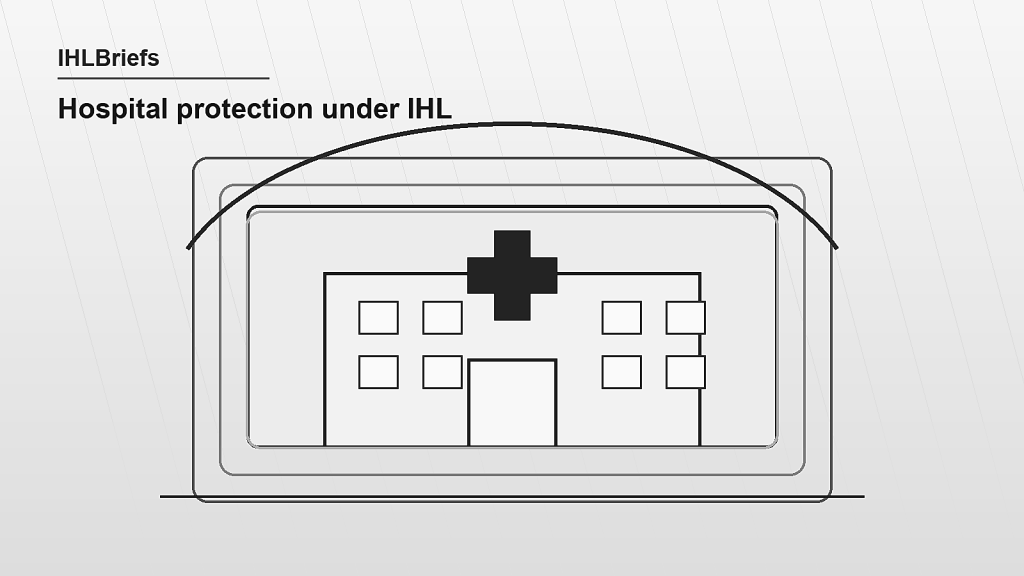
Hospitals enjoy special protection under IHL. That protection can be lost if they are used for acts harmful to the enemy, but allegation alone is not enough, and even loss of special protection does not erase proportionality, precautions, warnings, or protection of the wounded and sick.
Article details
Article type: Explainer / case note
Author: Artur Hodin
Published: 13 May 2026
Last updated: 13 May 2026
Reading time: 12 min
Tags: hospitals, medical protection, wounded and sick, Gaza, conduct of hostilities, civilian protection, IHL
Brief at a glance
Core point: Hospitals are specially protected under IHL because they care for the wounded and sick. That protection can be lost if a hospital is used, outside its humanitarian function, to commit acts harmful to the enemy. But the legal test is strict: allegation alone is not enough, warning is required where appropriate, and general conduct-of-hostilities rules still apply.
Why this article matters: Public debate often swings between two false extremes: “hospitals can never be attacked” and “any armed presence makes a hospital fair game.” IHL rejects both shortcuts.
Legal issue
When does a hospital lose its special protection under IHL, and what legal obligations remain even if protection is lost?
Main legal takeaway
A hospital does not lose protection because a party alleges misuse, because wounded fighters are treated there, or because armed guards protect the facility. Protection may cease only if the hospital is used outside its humanitarian function to commit acts harmful to the enemy, and only after due warning has been given and remains unheeded where warning is required. Even then, the wounded, sick, medical personnel, and civilians remain protected, and any attack must still satisfy military-objective, proportionality, and precaution rules.
Why it matters operationally
Hospitals are not ordinary civilian buildings. They are places where civilian suffering concentrates: wounded fighters no longer taking part in hostilities, injured civilians, newborns, pregnant women, older people, medical staff, displaced families, and patients who cannot move. When hospitals stop functioning, the harm spreads far beyond the building. Surgery stops. Dialysis stops. Maternity care stops. Vaccination, triage, burn care, rehabilitation, and emergency care collapse.
That is why IHL gives hospitals special protection. But that protection is not a license for armed actors to use hospitals as shields, command posts, weapons stores, or firing positions. Misuse of medical facilities can endanger patients, staff, and the entire protective system.
The legal task is to hold both ideas together: hospitals must not be misused, and allegations of misuse do not erase the law.
Recent reporting about Nasser Hospital in Gaza illustrates the difficulty. Doctors Without Borders stated that it suspended non-critical activities in January 2026 after staff and patients saw armed men, intimidation, arbitrary arrests of patients, and suspected movement of weapons in parts of the hospital compound. MSF also stated that it did not have sufficient evidence to conclude that the hospital was being used for organized military operations, and later resumed core activities after improvements. That kind of record requires careful legal analysis, not slogans.
Visual: hospital protection stack
The hospital cares for wounded and sick persons.
Medical units must be respected and protected.
Is there an act harmful to the enemy outside the humanitarian function?
Has due warning been given, with reasonable time where appropriate, and remained unheeded?
Does the object now make an effective contribution to military action and would attack offer a definite military advantage?
Proportionality, precautions, and protection of wounded/sick and medical personnel still apply.
Facts and status
Known law
Hospitals and medical units are specially protected under IHL. They may lose protection only under limited conditions.
Known operational risk
Hospital misuse by armed actors can endanger patients and staff and undermine trust in medical protection.
Reported example
MSF reported armed men, intimidation, arbitrary arrests of patients, and suspected weapons movement at Nasser Hospital, while also stating it lacked evidence of organized military operations.
Common error
Public debate often treats allegation as proof or treats any misuse as automatic permission to attack. IHL requires a stricter analysis.
Applicable legal framework
This article concerns IHL protections for medical units and the wounded and sick. The rules apply in both international and non-international armed conflicts through treaty and customary law, though the exact treaty provisions depend on classification and treaty status.
Key rules and concepts:
- Respect and protect medical units. Hospitals, medical units, medical personnel, and medical transports must be respected and protected while performing their medical function.
- Care without adverse distinction. The wounded and sick must be collected and cared for without adverse distinction. Treating wounded fighters does not make a hospital a military objective.
- Acts harmful to the enemy. A medical unit may lose special protection if it is used, outside its humanitarian function, to commit acts harmful to the enemy. Examples may include using a hospital as a base to launch attacks, an observation post to transmit military information, a weapons depot, a liaison center with fighting troops, or a shelter for able-bodied combatants.
- Non-harmful acts. The presence of wounded or sick combatants, small arms taken from them and not yet handed over, or armed guards for the medical facility does not by itself count as an act harmful to the enemy.
- Warning and time. Before protection ceases, a due warning must be given where appropriate, with a reasonable time limit where appropriate, and the warning must remain unheeded.
- Special protection and general protection are distinct. Recent legal scholarship emphasizes that loss of special protection does not automatically mean the hospital may be attacked. The object must still meet the general military-objective test, and proportionality and precautions still apply.
The legal test: before anyone says “the hospital lost protection”
Is it a recognized hospital, medical unit, clinic, ambulance station, field hospital, or mixed-use compound?
Is the allegation specific, current, and supported by evidence, or is it broad and rhetorical?
Treating wounded fighters is protected. Storing weapons, launching attacks, or transmitting military intelligence is not.
Does it interfere directly or indirectly in military operations in a way that causes harm to the opposing party?
Was due warning issued, with reasonable time where appropriate, and did it remain unheeded?
Does the facility, by use, make an effective contribution to military action, and would attacking it offer a definite military advantage?
What civilian harm is expected? Can patients be evacuated? Can a narrower measure end the harmful act?
Strongest argument that protection may be lost
The strongest argument for loss of protection arises where there is reliable, current evidence that an armed group is using the hospital outside its humanitarian function to conduct military operations. Examples include launching attacks from the facility, storing weapons for operational use, using the hospital as a command post, transmitting targeting information, or sheltering able-bodied fighters to shield them from attack.
If such conduct is ongoing, warning is given and ignored, and the facility by its use makes an effective contribution to military action, the special protection of the medical unit may cease. In that situation, the opposing party is not required to let the harmful use continue indefinitely.
This argument is strongest when the evidence is specific, time-sensitive, independently corroborated where possible, and connected to concrete military advantage rather than general suspicion.
Strongest argument against attack
The strongest argument against attack is that IHL sets a high threshold because the humanitarian cost of hospital attacks is severe and often irreversible.
A hospital does not lose protection merely because it treats wounded fighters. It does not lose protection because armed guards are present. It does not lose protection because a party claims the enemy has influence over the surrounding area. It does not automatically lose protection because armed men are seen somewhere in a large compound. The legal question is what those persons are doing, whether the conduct is outside the humanitarian function, whether it harms the enemy, whether it is current, whether warning was given, and whether attacking the facility is still lawful under general targeting rules.
Even where misuse exists, a raid, search, evacuation, arrest, isolation of a wing, negotiation, or other non-attack measure may be feasible. IHL requires attention to feasible precautions and alternatives, especially because patients and medical staff remain protected.
Analysis
1. Allegation is not proof
Public allegations about hospitals are common in modern conflicts. Some are true. Some are exaggerated. Some are impossible to verify immediately. Legal analysis cannot treat accusation as conclusion.
A serious assessment asks: What exactly is alleged? Who observed it? When? In which part of the facility? Was the conduct ongoing? Was it connected to military operations? Did the party alleging misuse provide evidence? Did medical staff, humanitarian actors, satellite imagery, or independent investigators corroborate it? Could the conduct have another explanation?
The difference between “armed men were seen in a hospital compound” and “the hospital was used as a command center to direct attacks” is legally significant.
2. Misuse by armed actors is itself a protection failure
Using a hospital for military purposes can violate IHL because it endangers the wounded, sick, medical staff, and civilians. It also undermines confidence in all medical facilities, making future attacks more likely and humanitarian negotiation harder.
This point matters for neutrality. Condemning unlawful attacks on hospitals does not require ignoring misuse by armed actors. The law protects hospitals because of their medical function. Armed actors who exploit that function for military advantage attack the protective system from the inside.
3. Loss of special protection does not erase every other rule
This is the part of the law most often missed in public debate. Even if a hospital loses special protection, the legal analysis does not stop.
The attacker must still ask whether the facility, by its use, qualifies as a military objective. The attacker must still assess proportionality. The attacker must still take feasible precautions. The attacker must still protect the wounded and sick as far as possible. A warning requirement may still apply. The presence of patients and medical staff remains legally relevant.
The practical result is that the same alleged misuse might justify different responses depending on the facts. A small weapons cache in an isolated storage room, a firing position on the roof, and a command center embedded in an intensive-care wing are not the same legal case.
4. The Nasser Hospital reporting shows why legal caution matters
MSF’s February 2026 statement about Nasser Hospital is legally significant because it identifies conduct that threatens medical neutrality and safety: armed men, intimidation, arbitrary arrests of patients, and suspected movement of weapons. Those facts, if established, are serious.
But MSF also stated that it did not have sufficient evidence to conclude that the hospital was being used for military purposes such as organized military operations. That second sentence is just as important as the first. It shows the difference between a serious protection concern and a completed legal conclusion that the hospital became a lawful target.
The later resumption of core MSF activities after improvements also matters. It suggests that practical protection measures – management changes, restrictions on weapons and armed individuals, engagement with authorities – may reduce risk without treating the entire facility as a battlefield.
What not to overclaim
Do not write that armed presence automatically makes a hospital attackable. Do not write that hospitals can never lose protection. The legally serious position is that misuse must be specific, evidenced, outside the humanitarian function, harmful to the enemy, and still subject to warning, military-objective, proportionality, and precaution rules.
Protection implications
Hospital protection is a practical survival issue.
First, patients cannot simply leave. Evacuation may be medically impossible, especially for newborns, intensive-care patients, dialysis patients, trauma patients, and people under anesthesia or with severe burns.
Second, medical staff are hard to replace. Killing, detaining, displacing, or intimidating health workers can collapse services for thousands of people.
Third, attacks on hospitals create system-wide fear. Civilians may avoid seeking treatment. Ambulances may stop moving. Humanitarian organizations may reduce operations. Armed groups may further exploit medical spaces, or parties may treat all medical spaces with suspicion.
Fourth, legal ambiguity can itself harm protection. If parties believe that vague allegations are enough to justify attack, hospitals become vulnerable. If armed groups believe medical protection is absolute no matter how they use a hospital, patients become shields. IHL tries to prevent both failures.
What facts would change the analysis
The legal assessment would change depending on:
- whether the hospital was recognized and functioning as a medical unit;
- whether armed persons were guards, police, patients, fighters, or organized military personnel;
- whether weapons were stored temporarily, moved through, or used operationally;
- whether attacks were launched or directed from the facility;
- whether the conduct occurred in one room, one wing, or the whole compound;
- whether the party alleging misuse issued a warning and allowed time to correct the misuse;
- whether patients and staff could be evacuated safely;
- whether narrower measures could stop the harmful act;
- whether the expected civilian harm would be excessive;
- whether post-incident evidence supports or contradicts the initial allegation.
What cannot be concluded yet
This article cannot determine whether any specific hospital attack was lawful or unlawful without incident-level evidence. That would require intelligence, warnings, timing, target selection, proportionality assessments, available alternatives, casualty estimates, evacuation feasibility, and after-action information.
It also cannot determine from public sources alone whether armed presence in a hospital compound amounted to acts harmful to the enemy. Some forms of armed presence may be unlawful or dangerous without meeting the full threshold that would permit attack.
What can be concluded is the legal structure: hospital protection is strong, not absolute; misuse is serious, not automatically attack-authorizing; and patients, medical staff, and the wounded and sick remain protected even when a facility is misused.
Final assessment
A hospital does not become a battlefield by allegation. But it also does not remain protected because parties call it a hospital while using it for military operations.
The law’s discipline is in the sequence: evidence first, legal test second, warning where required, military-objective assessment, proportionality, precautions, and continuing protection for the wounded and sick. That sequence is what separates IHL analysis from propaganda.
Sources used
Primary law and legal framework
- Geneva Convention IV, Article 19 – discontinuance of protection of civilian hospitals.
- Additional Protocol I, Article 12 – protection of medical units.
- ICRC Customary IHL Database, Rule 25 – medical personnel.
- ICRC Customary IHL Database, Rule 28 – medical units.
- ICRC Customary IHL Database, Rules 14 and 15 – proportionality and precautions.
Institutional and expert sources
- ICRC, The protection of hospitals during armed conflicts: What the law says.
- International Review of the Red Cross, Thibaud Jourdan, When loss of protection does not permit attack: Distinguishing acts harmful to the enemy from the notion of military objectives, 2026.
- Doctors Without Borders / MSF statements on Nasser Hospital, February-April 2026.
- WHO, In the Line of Fire: Protecting Health in Armed Conflict.
Disclaimer: IHLBriefs is written in a personal capacity for educational and professional-portfolio purposes. It is not legal advice and does not represent the views of any university, employer, humanitarian organization, or institution with which the author is or has been affiliated.
