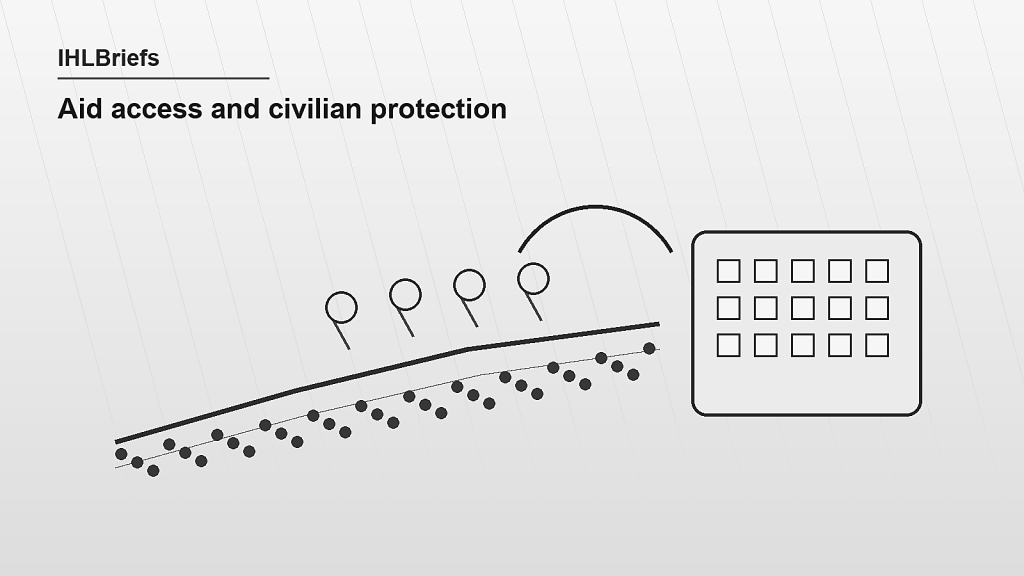
Aid distribution is not only a logistics question. When civilians must move through dangerous routes or militarized distribution points to survive, IHL analysis must examine starvation, humanitarian access, crowd-control force, and the protection consequences of the aid model itself.
Article details
Article type: Case note
Author: Artur Hodin
Published: 13 May 2026
Last updated: 13 May 2026
Reading time: 12 min
Tags: humanitarian access, starvation, Gaza, civilian protection, aid distribution, conduct of hostilities, humanitarian relief
Brief at a glance
Core point: Humanitarian aid is not legally adequate simply because some food enters a territory. The legal analysis must ask whether civilians can access relief safely, impartially, and without being exposed to avoidable violence, coercion, or deprivation.
Why this article matters: Aid distribution can become a protection risk when civilians must cross dangerous terrain, enter militarized zones, or face gunfire while seeking food. IHL analysis should therefore examine the design of the aid system, not only the number of trucks or boxes delivered.
Legal issue
When civilians are hungry and relief is restricted, rerouted, militarized, or dangerous to access, what does IHL require from parties to the conflict and those controlling humanitarian access?
Main legal takeaway
IHL prohibits starvation of civilians as a method of warfare and requires parties to allow and facilitate rapid and unimpeded passage of impartial humanitarian relief for civilians in need, subject to lawful control. Those duties are not satisfied by creating an aid mechanism that civilians can reach only at grave risk. If the route, site, crowd-control method, or security design predictably exposes civilians to death or serious injury, the aid system itself becomes part of the protection analysis.
Why it matters operationally
Food distribution is often discussed as logistics: how many trucks entered, how many pallets were unloaded, how many meals were delivered, how many warehouses were replenished. Those numbers matter. They can show whether needs are being met and whether humanitarian operations are being obstructed.
But protection work asks a second question: what happens to civilians on the way to relief?
A food parcel has little humanitarian value if civilians are killed, injured, humiliated, arbitrarily screened, separated, or forced through military-controlled corridors to receive it. An aid system may look functional on paper while failing in protection terms. The legal issue is not only supply. It is safe, impartial, non-discriminatory access to objects indispensable to civilian survival.
This article uses Gaza-related reporting and institutional statements as the public example because the controversy over aid distribution sites has made the issue unusually visible. The legal test, however, is broader. It applies wherever parties to armed conflict control relief, restrict access, or design systems that shape how civilians reach food, water, medicine, or shelter.
Visual: aid access risk chain
1. Need
Are civilians inadequately supplied with food, water, medicine, shelter, or fuel?
2. Access route
Can civilians reach relief safely, or must they move through dangerous areas?
3. Distribution site
Is the site civilian-centered, impartial, and accessible, or militarized and coercive?
4. Security method
Is force used only when lawful and necessary, or as crowd control against civilians?
5. Delivery
Does aid reach the most vulnerable, or only those able to survive the route and crowd?
6. Aftermath
Are injuries, deaths, exclusion, or repeated fear built into the system?
Facts and status
Known
Humanitarian agencies have reported severe constraints on aid delivery in Gaza, including insecurity, access restrictions, fuel scarcity, supply-chain disruption, and shortages of essential goods.
Reported
UN and human rights sources reported repeated killings and injuries of civilians near aid distribution sites in 2025, including sites linked to the Gaza Humanitarian Foundation system.
Contested
Responsibility for particular incidents, the circumstances of gunfire, the conduct of crowds, and the role of armed actors are disputed in many reported events.
Unknown
Public sources often do not provide complete information on rules of engagement, crowd-control instructions, site design decisions, warnings, military threat assessments, or internal investigations.
OCHA reported in April 2026 that humanitarian operations in Gaza continued under severe constraints, including insecurity, access restrictions, fuel scarcity, disruptions to the supply chain, overcrowded displacement sites, limited transport, and shortages of essential materials. It also reported that aid workers continued providing supplies and services while needs often outpaced what could be delivered.
OHCHR stated in June 2025 that people had been killed and injured around a Gaza Humanitarian Foundation distribution site for a third consecutive day and called for prompt and impartial investigations. Human Rights Watch later alleged that mass-casualty incidents had occurred near GHF sites and argued that the system had exposed civilians seeking food to serious harm. Those are serious allegations, not court judgments. They should be treated as part of the public record requiring legal analysis and investigation.
Applicable legal framework
This article concerns IHL, with related human rights implications where forces exercise control over civilians or use force in a policing/crowd-control setting. It does not resolve international criminal responsibility for specific individuals.
Key rules:
- Starvation of civilians as a method of warfare is prohibited. This includes more than physically destroying food. Deliberately depriving civilians of objects indispensable to survival, including through the wilful obstruction of relief, may fall within the prohibition.
- Objects indispensable to civilian survival are specially protected. Foodstuffs, agricultural areas, drinking water installations, and other survival objects are protected against attack, destruction, removal, or rendering useless for the purpose of starving civilians.
- Humanitarian relief must be allowed and facilitated. Parties must allow and facilitate rapid and unimpeded passage of impartial humanitarian relief for civilians in need, subject to their right of control.
- Parties must distinguish civilians from fighters. Civilians seeking aid remain civilians unless and for such time as they directly participate in hostilities. Hunger, movement, crowding, or desperation do not remove civilian protection.
- Force near aid sites must be legally justified. Where the situation is not an attack in the conduct-of-hostilities sense but a crowd-control or security setting, human rights standards on necessity and proportionality may also be relevant. Lethal force cannot be used merely to manage disorder or disperse civilians.
- Humanitarian principles matter operationally. Neutrality, impartiality, independence, and humanity are not just branding language. If an aid model becomes dependent on military control, private security, restricted access, or coercive routing, it may undermine the protective function of humanitarian relief.
Legal test: is the aid system protective or dangerous?
Are civilians inadequately supplied with food or other survival essentials?
Which party controls entry, distribution, movement, security, and access to the aid site?
Is aid distributed according to need without adverse distinction?
Can civilians reach and leave the site without predictable exposure to gunfire, shelling, arrest, abuse, or extreme crowd crush?
Were safer routes, more local distribution points, UN-led channels, community-based systems, or different timing feasible?
When civilians were injured or killed, did the responsible actors investigate, redesign the system, suspend dangerous practices, or continue the same model?
Strongest lawful-position argument
The strongest lawful-position argument is that parties to a conflict may control humanitarian relief to prevent diversion, protect security, and ensure that supplies do not strengthen an opposing armed group. IHL does not require parties to accept every proposed relief operation without conditions. It recognizes a right of control.
A party may argue that aid distribution near secured areas is intended to prevent looting, diversion, or armed-group control. It may also argue that force used near distribution sites responded to concrete threats, crowd surges, unauthorized movement toward military positions, or the presence of fighters among civilians. In that view, the legal issue is not the aid system itself but whether particular security incidents were lawful under the circumstances.
This argument becomes stronger if there is evidence that aid diversion was significant, that site design reduced rather than increased civilian risk, that civilians were given safe routes and clear information, that force was used only against concrete threats, and that incidents were independently investigated.
Strongest violation-risk argument
The strongest violation-risk argument is that an aid system can become unlawful in effect even if it is described as humanitarian.
If civilians are already facing severe deprivation, and the only meaningful access to food requires them to cross dangerous terrain, enter militarized areas, queue in chaotic crowds, and risk gunfire, the system may fail the protective purpose of humanitarian relief. If repeated killings or injuries occur and the model continues without adequate redesign, the foreseeability of harm becomes central.
The violation-risk argument is especially serious where:
- ordinary humanitarian channels are blocked or sidelined;
- distribution points are too few, too distant, or placed in militarized zones;
- the strongest and fastest obtain food while the most vulnerable are excluded;
- live fire is used as crowd control;
- civilians are forced to choose between hunger and physical danger;
- relief is used to induce movement, concentration, screening, or displacement.
Analysis
1. Aid entry is not the same as humanitarian access
A common mistake is to treat “aid entered” as the end of the legal question. It is not. Humanitarian access includes the ability of impartial relief to reach civilians in need and the ability of civilians to receive relief safely and without adverse distinction.
If aid is offloaded at a crossing but cannot be collected because of insecurity or access restrictions, the legal and protection problem remains. If aid reaches a site but civilians cannot safely reach the site, the legal and protection problem remains. If aid reaches some civilians but excludes the most vulnerable because the route requires physical strength, money, information, or risk tolerance, the protection problem remains.
2. Starvation analysis requires intent and method, but not only death counts
Starvation under IHL is not limited to civilians dying of hunger. The rule concerns the use of starvation as a method of warfare, including deprivation of objects indispensable to survival. The analysis therefore looks at conduct: obstruction, destruction, removal, denial, restriction, and the use of food access as leverage.
That said, legal caution is necessary. Not every food shortage proves starvation as a method of warfare. Armed conflict itself can disrupt logistics. Roads can be destroyed. Fighting can make delivery dangerous. Armed groups may steal or divert supplies. The legal assessment depends on evidence of intent, foreseeability, control, alternatives, and the cumulative effect of restrictions.
3. Militarized aid distribution creates foreseeable protection risks
When aid is distributed through a system closely tied to military control or armed security, civilians may be exposed to multiple dangers at once: movement through combat areas, crowd panic, lack of registration, limited opening times, confusion over rules, screening, arrest, and use of force.
The legal issue is not whether security is always improper. Some level of security may be necessary to protect aid workers and recipients. The problem is when the security design turns relief into a high-risk encounter between hungry civilians and armed forces.
A protection-centered aid model asks: can the elderly, children, wounded, disabled people, pregnant women, and families without transport reach the aid? Can civilians leave safely? Are distributions local enough to avoid dangerous mass movement? Is there a complaint mechanism? Are incidents investigated? Are routes and schedules clear? Are armed actors separated from humanitarian decision-making?
4. The use of lethal force near aid sites requires special scrutiny
Civilians seeking food do not lose protection because they are in a crowd. A crowd can contain threats, but crowd presence alone does not convert civilians into lawful targets. Where armed forces confront civilians seeking aid, the legal framework may include both IHL and international human rights law, especially if the force is used in a law-enforcement or crowd-control context rather than as an attack against a military objective.
The most legally dangerous scenario is using live fire to manage movement, panic, or disorder rather than to respond to an imminent threat. If civilians are repeatedly killed near known aid routes or sites, the burden on the controlling actors to change the system becomes heavier.
What not to overclaim
Do not turn every allegation near an aid site into a final war-crimes conclusion. The public record often lacks complete information about particular incidents. The legally careful claim is that repeated civilian casualties near aid distribution points require investigation and may indicate deeper IHL failures in the design and control of the aid system.
Protection implications
This issue matters directly for protection work.
First, civilians may be harmed not only by the absence of aid but by the process of obtaining aid. Hunger changes behavior. People take risks they would otherwise avoid. An aid model that ignores this reality can amplify harm.
Second, the most vulnerable may be excluded. Older people, disabled people, unaccompanied children, women caring for children, the wounded, and families far from distribution points may be unable to reach centralized sites. An aid system can therefore be formally open but practically discriminatory.
Third, humanitarian actors may lose acceptance. If communities associate aid with military screening, private security, danger, or humiliation, humanitarian trust erodes.
Fourth, repeated violence near aid sites may change displacement patterns. Families may move closer to distribution points, avoid certain areas, split households, or send young men and boys to collect food because they are perceived as physically able to survive the route. Each adaptation creates new protection risks.
What facts would change the analysis
The legal assessment would change depending on:
- whether safer UN-led or community-based distribution was feasible;
- whether restrictions on ordinary humanitarian actors were lawful and necessary;
- whether aid diversion was documented and serious;
- whether civilians were given safe, clear, and realistic access routes;
- whether sites were placed near military objectives or inside militarized zones;
- whether live fire was used against concrete threats or as crowd control;
- whether vulnerable groups could access relief;
- whether repeated civilian casualties led to redesign, suspension, or investigation;
- whether distribution was used to induce movement, screening, or concentration of civilians.
What cannot be concluded yet
This article cannot determine criminal responsibility for specific individuals without incident-level evidence, rules of engagement, command information, forensic documentation, witness assessment, and independent investigation.
It also cannot determine from public sources alone whether every incident near an aid site involved civilians only, armed actors, warning shots, crossfire, panic, or deliberate targeting. Those facts matter.
What can be concluded is narrower: IHL analysis of humanitarian relief must examine safe access, not only aid volume. A system that repeatedly exposes hungry civilians to serious danger cannot be treated as legally or humanitarianly adequate simply because some food is distributed.
Final assessment
Food lines are not free-fire zones. Civilians do not become less protected because they are desperate, crowded, hungry, or trying to reach relief.
The central legal question is whether the aid system protects civilians or makes survival conditional on danger. IHL requires more than symbolic delivery. It requires respect for the protective purpose of humanitarian relief: civilians in need must be able to receive assistance safely, impartially, and without being used as instruments of military control.
Sources used
Primary law and legal framework
- ICRC Customary IHL Database, Rule 53 – Starvation as a method of warfare.
- ICRC Customary IHL Database, Rule 55 – Access for humanitarian relief to civilians in need.
- Additional Protocol I, Article 54 – Protection of objects indispensable to the survival of the civilian population.
- Additional Protocol II, Article 14 – Protection of objects indispensable to the survival of the civilian population.
Institutional and factual sources
- ICRC statement to the UN Security Council on conflict-related food insecurity and starvation, 17 November 2025.
- OCHA, Humanitarian Situation Report – Gaza/OPT, 2 April 2026.
- OHCHR, statement on attacks around aid distribution sites in Gaza, 3 June 2025.
- Human Rights Watch, report on killings of Palestinians seeking food, 1 August 2025.
- MSF, OCHA, WHO, and UN reporting on humanitarian access and health-system constraints where relevant.
Disclaimer: IHLBriefs is written in a personal capacity for educational and professional-portfolio purposes. It is not legal advice and does not represent the views of any university, employer, humanitarian organization, or institution with which the author is or has been affiliated.
