AI can support military decision-making, but it cannot carry the legal judgment required by IHL. The hard question is not whether algorithms are useful; it is whether humans still understand, constrain, and remain responsible for the use of force.
Article details
Article type: Longer analysis
Author: Artur Hodin
Published: 13 May 2026
Last updated: 13 May 2026
Reading time: 11 min
Tags: artificial intelligence, autonomous weapons, targeting, conduct of hostilities, weapons law, civilian protection, Article 36
Brief at a glance
Core point: AI systems may help collect, sort, rank, or display information in armed conflict. They may even be integrated into autonomous weapon systems. But IHL compliance still depends on human legal judgment: distinction, proportionality, feasible precautions, and accountability cannot be outsourced to software.
Why this article matters: The public debate often asks whether AI weapons should be banned or accepted. A more immediate legal question is narrower: what must a human still understand and decide before force is used?
Legal issue
When AI is used to support or automate targeting, what does IHL require of the humans who design, authorize, supervise, and deploy the system?
Main legal takeaway
IHL is technologically neutral, but it is not judgment-neutral. Whether a weapon uses a rifle sight, satellite feed, pattern-recognition system, or autonomous sensor package, humans remain responsible for applying the rules on distinction, proportionality, precautions, and weapons review. The legal problem with AI targeting is not that machines process information. The problem is when the human user no longer understands the system well enough to make the legal judgments IHL requires.
Why it matters operationally
AI is attractive in warfare because it promises speed. It can process surveillance data, identify patterns, recommend targets, support counterfire, prioritize threats, and reduce some forms of human error. In high-tempo operations, especially against missile launchers, drones, air defenses, cyber infrastructure, or dispersed armed groups, commanders may see algorithmic tools as necessary rather than optional.
That is exactly why the legal question matters. IHL rules are applied before and during attacks, often under pressure and uncertainty. If an AI-enabled tool compresses the time between detection and strike, it may also compress the time available for legal assessment. If an autonomous weapon selects and engages targets after activation, the user may not know the precise person, object, time, or location that will be struck. If a decision-support system ranks thousands of possible targets, the human may be tempted to approve the output rather than interrogate it.
The career-relevant point for IHLBriefs is this: a serious legal/protection analyst should not simply say “AI is illegal” or “AI is just a tool.” Both statements are too crude. The better question is whether the system leaves humans with enough knowledge, time, control, and accountability to comply with IHL.
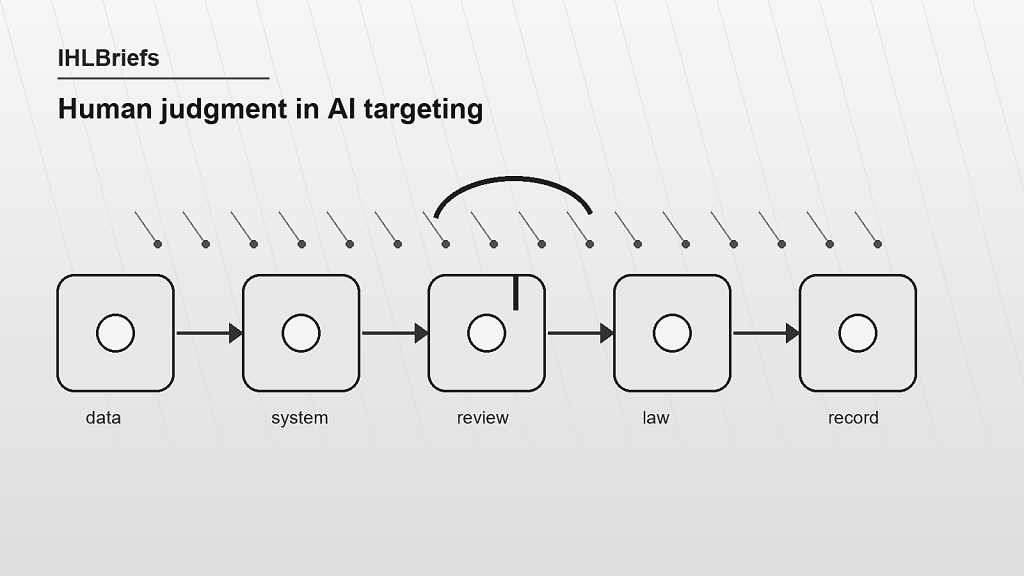
Visual: the targeting judgment chain
1. Data
What is being collected, from where, and with what error risk?
2. System output
Does the tool identify, rank, recommend, or engage?
3. Human review
Can a trained human understand and challenge the output?
4. Legal judgment
Distinction, proportionality, precautions, and weapon limits.
5. Accountability
Who can explain and review the decision afterward?
Facts and status
Known
States and militaries are increasingly interested in AI-enabled decision-support systems, autonomous weapon systems, swarming technologies, and faster targeting cycles.
Debated
States disagree on how much human control is required, whether new binding rules are necessary, and how to define systems that select and engage targets without further human intervention.
Legally settled
IHL applies to new technologies. Existing rules on distinction, proportionality, precautions, and weapons review do not disappear because a system uses AI.
Unresolved
The hard questions concern predictability, explainability, data quality, bias, human-machine interaction, and accountability across the life cycle of AI-enabled systems.
The ICRC describes autonomous weapon systems as weapons that, once activated, can select and engage targets without further human intervention. It emphasizes that the user may not know the specific target, timing, or location of the resulting force, and that IHL obligations must be fulfilled by humans rather than by the weapon system itself.
The CCW Group of Governmental Experts on lethal autonomous weapons systems has continued to discuss possible elements of an instrument or other measures on emerging technologies in the area of LAWS. The fact that the debate continues is itself important: there is broad agreement that IHL applies, but there is no full agreement on what additional rules or limits are required.
Applicable legal framework
This article concerns jus in bello, not jus ad bellum. It does not ask whether a state may use force under the UN Charter. It asks how IHL applies once an armed conflict exists and force is being used.
Key rules and concepts:
- Distinction. Parties must distinguish between civilians and combatants and between civilian objects and military objectives. An AI system that cannot support reliable distinction in its intended environment creates a serious legal problem.
- Military objective. For objects, the target must by its nature, location, purpose, or use make an effective contribution to military action, and its destruction, capture, or neutralization must offer a definite military advantage in the circumstances ruling at the time.
- Proportionality. Even if the target is lawful, an attack is prohibited if expected incidental civilian harm would be excessive in relation to the concrete and direct military advantage anticipated.
- Precautions. Parties must take feasible precautions to verify targets, choose means and methods that reduce civilian harm, and cancel or suspend attacks if the legal assessment changes.
- Weapons review. For states bound by Additional Protocol I, Article 36 requires review of new weapons, means, or methods of warfare to determine whether their use would be prohibited in some or all circumstances. Even outside AP I treaty obligations, legal review is a serious compliance tool for AI-enabled capabilities.
- Accountability. The presence of AI does not dissolve responsibility. A system that produces harm but leaves no human able to explain the assumptions, limits, training, data, and intended use creates legal and operational accountability problems.
The legal test: what human judgment must cover
Is it a decision-support tool, a sensor, a target-recognition aid, a cyber tool, a loitering munition, or an autonomous weapon system that selects and engages targets after activation?
Does the human select each target, approve a system-generated target list, set parameters, supervise execution, or merely activate a system and wait?
Will the system operate in open sea, airspace, a battlefield with few civilians, a dense city, a hospital area, a displacement route, or a mixed civilian-military environment?
Can the system reliably distinguish the target category from civilians and civilian objects in the actual environment, not just in testing?
Can humans estimate civilian harm, set limits, choose timing, suspend attacks, and deactivate the system if the situation changes?
Can the state or party reconstruct what happened, investigate errors, and adjust deployment if civilian harm occurs?
Strongest argument for AI-enabled targeting
The strongest lawful-position argument is not that AI replaces legal judgment. It is that AI may improve the factual basis for legal judgment.
A well-designed system might detect incoming fire faster than humans, compare multiple data streams, reduce cognitive overload, flag civilian presence, improve target verification, or suggest lower-risk timing. In some environments, such as defensive counterfire against clearly military systems, a fast decision-support tool may reduce harm by enabling more precise and timely responses. A human commander with better information may make better IHL decisions.
This argument is strongest where the environment is constrained, the target category is clear, civilians are absent or sparse, the system has been legally reviewed, and humans understand the tool’s limitations.
Strongest legal concern
The strongest concern is not science fiction. It is ordinary legal judgment being degraded by speed, opacity, and automation bias.
If a system ranks people or objects as targets but the human reviewer cannot understand the basis for the ranking, proportionality and precautions become thin. If the human has seconds to approve a recommendation, the review may become formal rather than real. If commanders trust the tool because it appears technical and neutral, they may under-question bad data, biased assumptions, or stale intelligence. If an autonomous system searches for a generalized target profile in a changing environment, the human may not know enough about the specific strike to assess civilian harm.
The ICRC’s position is especially important here: it argues that IHL obligations must be fulfilled by humans and that new rules are urgently needed to clarify and specify how IHL applies to autonomous weapon systems. That does not mean every AI-related tool is unlawful. It does mean the law cannot be satisfied by saying “the algorithm decided.”
Analysis
The legal question should be broken into three different categories.
1. AI as information support
This is the least controversial category. AI may help process surveillance data, translate communications, detect patterns, or identify possible objects of interest. The legal risk depends on how the output is used.
If the tool only helps humans find information, and humans still verify the target and apply the legal rules, the system may be compatible with IHL. But even here, the review must be real. A commander cannot treat an AI recommendation as a legal conclusion. The tool may say, “this object resembles a launcher.” It cannot say, in any meaningful legal sense, “this attack is proportionate.”
2. AI as decision support
This is the hardest practical category. Decision-support systems may produce target lists, confidence scores, risk ratings, or strike recommendations. The system does not fire the weapon, but it shapes the human decision.
The legal risk is automation bias. Humans may over-trust the output because it appears objective. The risk increases when the target list is large, the tempo is high, the source data is classified or inaccessible, and the reviewer cannot test the assumptions. In such cases, a human signature at the end of the process does not necessarily equal human judgment.
For IHL compliance, the human must be able to ask and answer basic questions: What is the target? Why is it considered a military objective? What is the expected civilian harm? What assumptions does the system rely on? What is the error rate? What facts would require cancellation or delay? What alternative means or timing would reduce harm?
3. AI in autonomous weapon systems
This category raises the sharpest issue because the system may select and engage targets after activation. The human may set parameters but not choose each target.
Autonomy is not automatically unlawful. Some older weapons, such as certain mines or defensive systems, have long operated without real-time human control. But modern AI-enabled autonomy can operate in more complex environments and with less predictable behavior. The more open the environment, the more varied the possible targets, and the more civilians may be present, the harder it becomes for humans to make the legal judgments in advance.
The lawfulness of use therefore depends heavily on constraints: target type, geographical area, duration, environmental conditions, ability to deactivate, supervision, reliability, and the civilian density of the area. A system deployed against incoming missiles at sea is legally different from a system searching an urban neighborhood for people matching a pattern.
What not to overclaim
Do not write that AI targeting is always unlawful. Also do not write that existing IHL answers every problem. The serious position is narrower: IHL applies, humans remain responsible, and some AI-enabled systems or uses may be impossible to reconcile with distinction, proportionality, precautions, or accountability unless tightly constrained.
Protection implications
AI targeting is not only a weapons-law issue. It is a civilian-protection issue.
First, errors can scale. A bad human decision may cause one unlawful attack. A bad model or flawed dataset can replicate error across many decisions.
Second, speed can shrink protection space. Civilian presence, medical status, surrender, displacement, and protected objects are often context-dependent. If the decision cycle becomes too fast for those facts to be noticed, civilian protection weakens.
Third, accountability can become blurred. Was the harm caused by the developer, the commander, the operator, the intelligence analyst, the trainer, the data provider, or the state that deployed the tool? IHL responsibility ultimately remains with humans and parties to conflict, but practical accountability becomes harder when decision chains are opaque.
Fourth, field protection work may be affected. Humanitarian actors negotiating civilian movement, medical access, or protection of infrastructure need parties to understand and control their own systems. A party that cannot explain how a system selects targets will be harder to engage in meaningful protection dialogue.
What facts would change the analysis
The legal assessment would change depending on:
- whether the system merely supports information review or actually selects and engages targets;
- whether the system is used in a civilian-dense environment;
- whether target categories are narrow and objectively identifiable;
- whether humans can understand the system’s basis for output;
- whether commanders can suspend or deactivate the system;
- whether the system has been reviewed under Article 36 or an equivalent legal-review process;
- whether post-use audits reveal recurring civilian-harm patterns;
- whether operators receive training on the system’s limits and legal risks.
What cannot be concluded yet
This article cannot conclude that any specific state system is lawful or unlawful without technical and operational details. Public descriptions of AI tools are usually incomplete. Legal assessment requires information about design, training data, target profile, environment, human-machine interaction, command responsibility, testing, error rates, and actual use.
It also cannot resolve the broader diplomatic debate over whether new treaty rules should prohibit or regulate certain autonomous weapon systems. The better conclusion is that existing IHL provides the baseline, but the baseline may need clarification where autonomy weakens human control over life-and-death decisions.
Final assessment
The useful question is not whether the future of warfare will include AI. It already does. The useful question is whether legal judgment remains meaningful when machines accelerate the path from data to death.
For IHL purposes, the algorithm is not the legal adviser, the commander, the proportionality assessor, or the accountable decision-maker. AI can support human judgment only if the human still has enough information, control, time, and training to exercise judgment. When that chain breaks, the problem is not just technical. It is legal and humanitarian.
Sources used
Primary law and legal framework
- ICRC IHL Database, Additional Protocol I, Article 36 – New weapons.
- ICRC Customary IHL Database: distinction, proportionality, precautions, and civilian protection rules.
Institutional and expert sources
- ICRC, Autonomous Weapon Systems and International Humanitarian Law: Selected Issues, 2026.
- UN Office for Disarmament Affairs, CCW Group of Governmental Experts on LAWS, 2025 documentation.
- ICRC, A Guide to the Legal Review of New Weapons, Means and Methods of Warfare.
- Lieber Institute, Articles of War AI and autonomous weapons series, 2025-2026.
Disclaimer: IHLBriefs is written in a personal capacity for educational and professional-portfolio purposes. It is not legal advice and does not represent the views of any university, employer, humanitarian organization, or institution with which the author is or has been affiliated.
