“The Meeting affirmed that the Convention does not allow the suspension of its operation and consequently its obligations.”
Final Report of the Twenty-Second Meeting of States Parties, paragraph 51
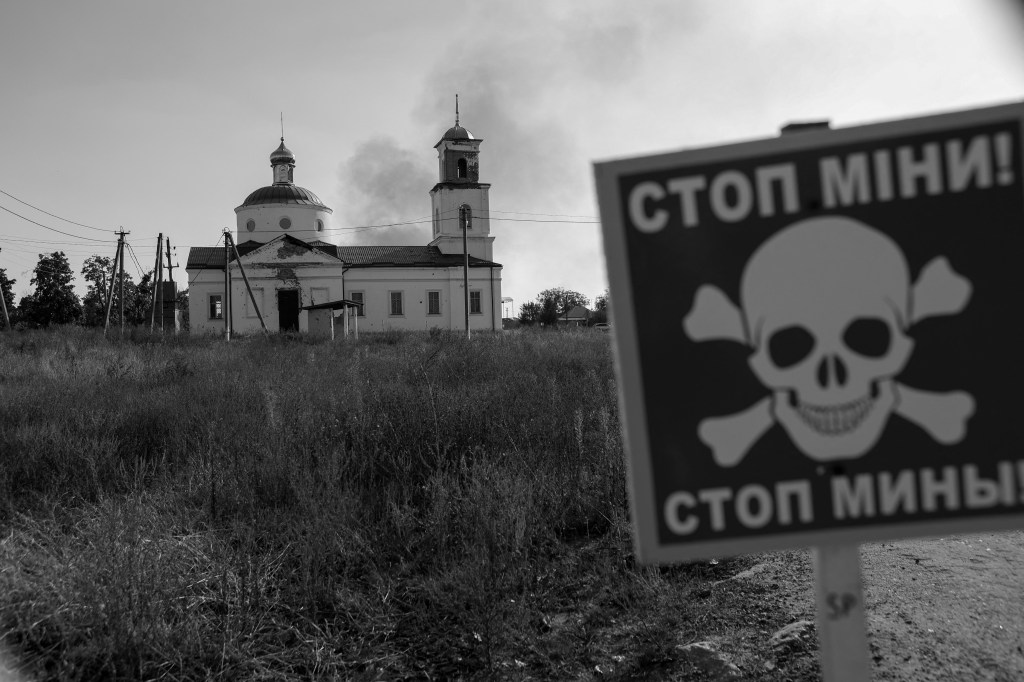
Anti-personnel mines have returned to European defense planning under acute security pressure. Following Russia’s full-scale invasion of Ukraine and the widespread deployment of minefields across the frontline, the categorical prohibition established by the 1997 Ottawa Convention is facing its most severe test since its adoption. Facing conventional warfare, asymmetric attrition, and border vulnerability along NATO’s eastern flank, Ukraine announced the wartime suspension of the Convention, while five European states (Estonia, Latvia, Lithuania, Finland, and Poland) notified their withdrawal from the treaty to restore defensive barrier capabilities.
These moves raise distinct legal questions. For states that completed withdrawal, the categorical ban is formally gone, leaving behind a narrower fallback regime. For Ukraine, the central question is whether a state defending itself against an adversary outside the treaty can unilaterally pause its obligations during war. While Ukraine’s security dilemma is genuine, the law of treaties and the Convention’s text leave little room for wartime suspension.
Article 20 Is Not An Exit
Article 1 of the Mine Ban Convention sets an unconditional standard: states undertake “never under any circumstances” to use, develop, produce, acquire, stockpile, retain, or transfer anti-personnel mines. Unlike some international instruments, the Convention contains no derogation clause and no mechanism for temporary suspension.
Instead, Article 20 expressly anticipates the wartime scenario. While a state may withdraw upon six months’ notice, Article 20(3) creates a specific safeguard: if the withdrawing state is engaged in an armed conflict when those six months expire, the withdrawal does not take effect until the conflict ends. The drafters foresaw that belligerents would face immense military incentives to reintroduce landmines during active hostilities. They deliberately designed the treaty so that exit is impossible during the very circumstance in which the temptation to use the weapon is greatest.
This rule highlights the difference between Ukraine and its European neighbors. The United Nations depositary records that Estonia, Latvia, and Lithuania completed their Article 20 withdrawals on 27 December 2025, Finland on 10 January 2026, and Poland on 20 February 2026—each having submitted notice while not engaged in an armed conflict. In contrast, Ukraine submitted a notification on 17 July 2025 claiming immediate suspension. Because Ukraine is in an international armed conflict, a standard withdrawal under Article 20 cannot take legal effect until hostilities terminate.
Testing the Vienna Convention on the Law of Treaties
To bypass Article 20, Ukraine invoked the general law of treaties under the Vienna Convention on the Law of Treaties (VCLT). As legal scholars like Robert Kolb have noted, two arguments are typically advanced: fundamental change of circumstances (Article 62) and state of necessity.
Under Article 62 of the Vienna Convention, a party may invoke rebus sic stantibus only if the unforeseen change transformed an essential basis of consent and radically alters the burden of performance. Ukraine can point to compelling factual realities: Russia is not party to the Convention, has deployed massive minefields documented by the Landmine Monitor, and NATO-bordering allies have withdrawn from the regime. Yet as the International Court of Justice emphasized in Gabčíkovo-Nagymaros, Article 62 is an exceptional remedy that cannot override treaties designed to operate in crisis.
Furthermore, Article 60(5) of the Vienna Convention bars suspension of humanitarian provisions relating to the protection of the human person, even in response to a material breach. While the Mine Ban Convention is formally a disarmament treaty, its object is inherently humanitarian: preventing indiscriminate civilian harm. Allowing reciprocal abandonment during war would unravel the entire foundation of humanitarian treaties.
Procedural hurdles under Article 65 of the Vienna Convention are equally strict. A state must provide reasoned notification and allow other parties at least three months to object. When Ukraine circulated its notice, multiple states parties formally objected, preventing any tacit consensus from forming.
The December 2025 States Parties Response: Institutional Weight vs. Judicial Effect
At the Twenty-Second Meeting of States Parties in December 2025, the assembly addressed Ukraine’s notification directly. Paragraph 51 of the Final Report explicitly affirmed that the Convention does not permit the suspension of its operation or obligations, calling on Ukraine to remain compliant.
The legal effect of this declaration requires nuance. Under the International Law Commission’s 2018 Conclusions on Subsequent Agreements and Practice, a conference decision functions as a binding subsequent agreement under VCLT Article 31(3)(a) only if it reflects substantive consensus among all parties. Because Ukraine maintains its contrary legal position, the report cannot be classified as a unanimous subsequent agreement, nor did the Meeting act as a court with binding judicial authority.
Nonetheless, the collective affirmation carries immense institutional weight. It definitively blocks any claim of state acquiescence or emerging subsequent practice that would allow wartime suspension. It confirms that within the treaty system, Ukraine remains legally bound as a State Party.
What Remains: The Fallback Legal Framework
When a state leaves or challenges the Mine Ban Convention, it does not step into a legal void. Mine warfare outside the Ottawa Convention remains subject to strict baseline rules under international humanitarian law:
1. CCW Amended Protocol II: For states party to Amended Protocol II of the Convention on Certain Conventional Weapons (CCW) (including Finland, Estonia, Latvia, Lithuania, Poland, and Ukraine) anti-personnel mines may only be used if they comply with strict technical specifications (such as mandatory self-destruction and self-deactivation mechanisms) and are deployed within marked, monitored, and recorded perimeters.
2. Customary IHL Restraints: Under customary international law, all belligerents are bound to minimize indiscriminate effects (Rule 81), record the location of all minefields (Rule 82), and remove or neutralize mines following the cessation of active hostilities (Rule 83).
Strategic Reality vs. Humanitarian Constraint
The debate over anti-personnel mines exposes the central tension of modern IHL: how to maintain categorical humanitarian norms when states face existential conventional aggression against an adversary that ignores those norms. Ukraine’s operational need for defensive parity is understandable, as is the desire of frontline European states to strengthen territorial deterrence.
Yet international law does not treat humanitarian disarmament as an optional peacetime instrument. The Ottawa Convention was drafted precisely to withstand the pressures of war. While former states parties can lawfully return to the regulated framework of CCW Amended Protocol II via Article 20, unilateral wartime suspension remains legally unrecognized. The law of armed conflict leaves room to debate military necessity, but it does not permit a party to unilaterally redefine its obligations when the battle begins.
