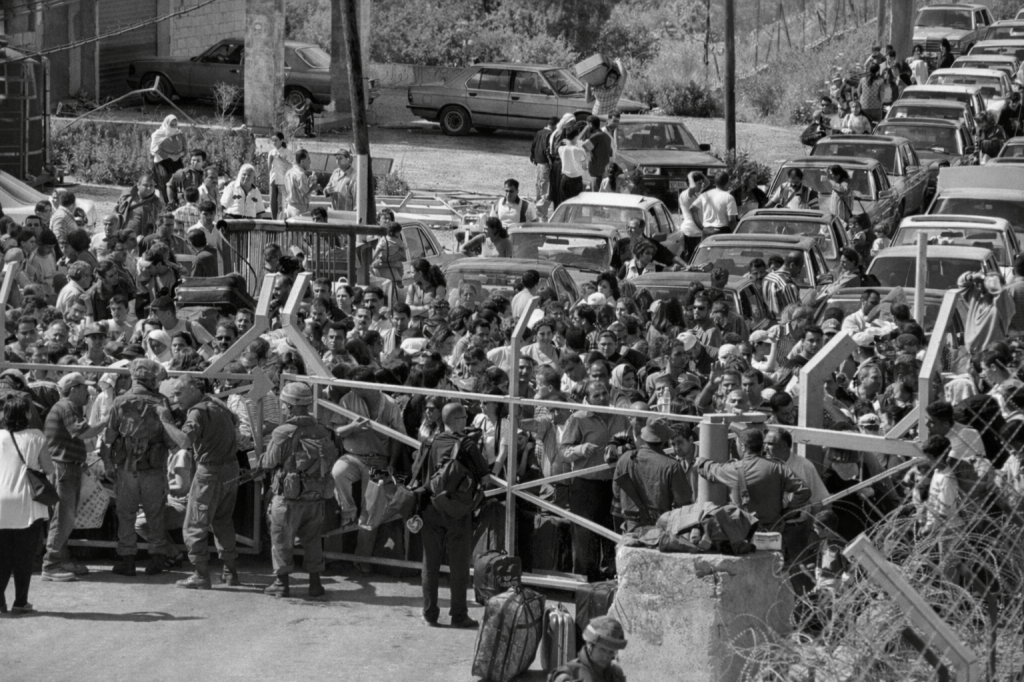
In March 2026, Israeli forces issued evacuation orders covering large parts of southern Lebanon and later extended them northward. The legal issue is narrower than the broader political debate. When does an evacuation order remain a lawful precaution, and when does it become unlawful displacement?
Main legal takeaway
IHL does not prohibit every evacuation order in war. A warning can be a lawful precaution.
The stronger legal question is whether these orders remained temporary and tied to civilian protection, or whether they became broad population removal backed by non-return and destruction. On the current public record, there are serious grounds to assess at least part of the policy as possible unlawful displacement rather than precaution alone.
How this article approaches the law
This article focuses on one issue: how IHL treats evacuation orders directed at civilians.
The main framework is customary IHL on warning, precautions against the effects of attacks, removal of civilians from the vicinity of military objectives, and displacement. If the facts support Common Article 2, occupation, or sustained territorial control, Geneva Convention IV Articles 49 and 53 become more central.
Lebanon is a party to Additional Protocol I and Additional Protocol II. Israel is not a party to the Additional Protocols. This brief therefore relies mainly on customary law and Geneva Convention IV rather than the Additional Protocols.
Reader key
Common Article 2 triggers the Geneva Conventions in conflicts between states and in occupation-type situations.
GC IV Article 49 prohibits forcible transfers and deportations from occupied territory and allows evacuation only on narrow grounds, with return required once hostilities in the area have ceased.
GC IV Article 53 restricts destruction of property in occupied territory unless military operations make that destruction absolutely necessary.
Customary Rule 20 requires effective advance warning of attacks that may affect civilians, unless circumstances do not permit.
Customary Rule 22 requires feasible precautions to protect civilians and civilian objects under a party’s control against the effects of attacks.
Customary Rule 24 requires parties, to the extent feasible, to remove civilians and civilian objects from the vicinity of military objectives.
Customary Rule 129 prohibits conflict-related displacement unless the security of the civilians involved or imperative military reasons so demand.
2 March 2026
On 2 March, the Israeli military ordered residents of towns and villages in southern Lebanon to move north of the Litani River. The order affected hundreds of thousands of residents and effectively depopulated an area covering about 8% of Lebanon. By 13 March, the orders covered roughly 14% of Lebanese territory and more than 800,000 people had already been displaced.
A warning is not unlawful by itself. A party expecting attacks near military objectives may warn civilians to leave.
The legal problem starts when an order becomes broad enough to resemble population removal rather than a targeted precaution.
5 to 13 March 2026
By early and mid-March, the orders had expanded beyond the initial southern zone. They affected Beirut’s southern suburbs and later the area between the Litani and Zahrani rivers. More than 100 towns and villages were reportedly covered, and the breadth of the orders made them difficult for civilians to follow safely.
An effective warning has to work in real conditions. If routes are unsafe, shelters are full, orders come at night, or civilians are displaced repeatedly into unstable areas, the existence of a warning does not end the analysis.
By 27 March, more than 370,000 children had been displaced. Shelters had also been struck. Those facts cut against the claim that the warnings were functioning as a reliable civilian-protection measure.
31 March 2026
On 31 March, Israel’s defence minister said more than 600,000 displaced residents would be barred from returning south of the Litani until northern Israel was secure. He also said homes in villages near the border would be destroyed.
This shifts the issue from warning to temporariness. Evacuation in IHL is exceptional and temporary. A policy of non-return paired with announced home destruction is harder to defend as precaution alone.
8 to 10 April 2026
On 8 April, Israeli forces issued a new evacuation order for Tyre and directed residents to move north of the Zahrani River. The same day brought the heaviest strikes of this phase of the war, with more than 250 people reported killed and more than 100 Hezbollah command centres and military sites reportedly hit within minutes.
The warning regime was still expanding. This was not a closed displacement episode.
Lebanon was also reported to be outside the U.S.-Iran ceasefire. That weakens any suggestion that the situation was moving into a return phase.
On 10 April, strikes reportedly damaged the last main bridge linking southern Lebanon with the rest of the country and threatened access to aid, food, and health care for civilians who remained south of the Litani.
That adds a second legal problem. The issue is not only whether civilians were ordered to move. It is also whether those who remained or tried to leave were left with restricted routes and weaker access to essentials.
What supports the policy legally
A party may warn civilians to leave areas expected to come under attack. It may also take feasible steps to move civilians away from military objectives. On that view, the initial orders can be framed as precautionary measures tied to anticipated strikes.
What creates legal pressure
The legal problem grows when warnings become broad, repeated, hard to follow safely, and detached from any clear return framework. It becomes stronger when the orders are paired with non-return language, announced destruction of homes, and damage to the routes civilians depend on to leave or receive aid.
Likely Geneva implications
The immediate framework is customary IHL on warning, precautions against the effects of attacks, civilian removal from the vicinity of military objectives, and displacement.
If control in the south remained temporary and fluid, those rules may do most of the work. If the facts instead support Common Article 2, sustained control, barred return, and systematic destruction of homes, Geneva Convention IV Articles 49 and 53 move closer to the center of the analysis.
Damage to the remaining bridge infrastructure south of the Litani adds a second pressure point. The issue is no longer only warning and non-return. It is also whether civilians were left with narrowing routes and weaker access to essentials.
Final assessment
IHL does not prohibit every evacuation order in war.
On the current public record, the March and April 2026 orders in Lebanon may have begun as precautionary warnings. Their breadth, weak practical effectiveness, repeated civilian flight, non-return language, announced home destruction, and later damage to key bridge access south of the Litani create serious grounds to assess at least part of the policy as possible unlawful displacement rather than precaution alone.
Selected sources
Primary legal authorities
Common Article 2 of the Geneva Conventions / Geneva Convention IV
https://ihl-databases.icrc.org/en/ihl-treaties/gciv-1949
Geneva Convention IV, Article 49
https://ihl-databases.icrc.org/en/ihl-treaties/gciv-1949/article-49
ICRC 2025 Commentary to Geneva Convention IV, Article 49
https://ihl-databases.icrc.org/en/ihl-treaties/gciv-1949/article-49/commentary/2025
Geneva Convention IV, Article 53
https://ihl-databases.icrc.org/en/ihl-treaties/gciv-1949/article-53
ICRC 2025 Commentary to Geneva Convention IV, Article 53
https://ihl-databases.icrc.org/en/ihl-treaties/gciv-1949/article-53/commentary/2025
ICRC Customary Rule 20
https://ihl-databases.icrc.org/en/customary-ihl/v1/rule20
ICRC Customary Rule 22
https://ihl-databases.icrc.org/en/customary-ihl/v1/rule22
ICRC Customary Rule 24
https://ihl-databases.icrc.org/en/customary-ihl/v1/rule24
ICRC Customary Rule 129
https://ihl-databases.icrc.org/en/customary-ihl/v1/rule129
Lebanon treaty status in the ICRC database
https://ihl-databases.icrc.org/en/ihl-treaties/treaties-and-states-parties?sort=state&state=17916
Israel statement on the Additional Protocols
https://www.un.org/en/ga/sixth/75/pdfs/statements/protocols/12mtg_israel.pdf
Reporting and field material
13 March 2026, evacuation orders affecting roughly 14% of Lebanese territory
https://www.reuters.com/world/middle-east/israeli-evacuation-orders-affect-14-lebanon-ngo-says-2026-03-13/
6 March 2026, blanket displacement orders, breadth, and doubts about effectiveness
https://www.ohchr.org/en/press-briefing-notes/2026/03/lebanon-israeli-blanket-displacement-orders-bring-more-misery
27 March 2026, more than 370,000 displaced children, shelters, and nighttime warnings
https://www.reuters.com/world/middle-east/unicef-says-over-370000-children-displaced-lebanon-121-killed-2026-03-27/
31 March 2026, non-return south of the Litani and announced destruction of homes
https://www.reuters.com/world/middle-east/israel-establish-buffer-zone-south-lebanon-up-litani-river-defence-minister-says-2026-03-31/
8 April 2026, Tyre evacuation order
https://www.reuters.com/world/middle-east/israel-issues-new-evacuation-order-tyre-southern-lebanon-saying-it-will-strike-2026-04-08/
8 April 2026, heaviest strikes and Lebanon outside the ceasefire
https://www.reuters.com/world/middle-east/hezbollah-pauses-attacks-under-us-iran-ceasefire-sources-close-group-say-2026-04-08/
10 April 2026, bridge damage and humanitarian-access issue
https://www.hrw.org/news/2026/04/10/lebanon-israeli-strikes-kill-hundreds-damage-vital-bridge
Legal commentary
Evacuation Orders: An Unlawful Use of Precautionary Measures?
https://www.ejiltalk.org/evacuation-orders-an-unlawful-use-of-precautionary-measures/
Civilian Evacuations and the Law of Armed Conflict
https://lieber.westpoint.edu/civilian-evacuations-law-armed-conflict/
